Build and test your strategy with code.
Venture Proof is a powerful, disruptive strategy-as-code engine. It builds and tests your strategy with code, so every step runs the same way and can be checked. Find out if your growth plan will work, then make it stronger, before you pay to find out the hard way.
A private Alpha is early access for a small group. It's not a public launch. This one is open only to leadership teams Mike Boysen advises. You get in by invite, through a call.
Why plans fail late
Teams often build the full product before they know the plan will work.
Building too soon
Teams skip the test. They pay to build software before they know the problem is real, or before they know customers will switch.
- The spend goes into a big build before the plan is tested
- The team copies what others already do, instead of checking the basics
- Nobody measures the waste and friction in the customer's job before they spend
- The result is easy for a bigger company to copy
Test the plan in three steps
Venture Proof builds and tests your strategy with code. You find out if the growth plan will work, and you make it stronger, before you pay to find out the hard way.
- Explore: Break the problem down to what is physically, legally, and economically true.
- Validate: Map the customer's job and score the physics gap on each step. The physics gap is the waste and friction in that job.
- Execute: Design what makes the model hard to copy, then run an MVPr. An MVPr is a manual concierge prototype. It's not full software.
What you can do with it
Tools that build the plan, test it, and show what to fix.
Stage gates
You move through Explore, Validate, and Execute. A stage gate is a checkpoint. Each one asks for proof before you go on.
AI tribunal
A tribunal is a group of AI checks scored against one rubric (a fixed scoring guide). It looks for weak logic, claims without proof, and hidden cost traps.
Physics gap map
The physics gap is the waste and friction in the job your customer is trying to get done. The map shows where that friction sits, step by step.
Ten kinds of advantage
A moat is what makes the model hard to copy. This lays out ten kinds, from how the business makes money to how the experience feels.
Proof you can trace
Claims link back to interview notes and to the prototype test, so you can check the source.
Three stages
How a growth plan moves from a guess to a test you can check.
Break the problem down
Take the problem apart. Look at the physical, legal, and money facts. Name the person who is trying to get the job done.
Score the friction
Map the job. A job map is the list of steps in that job. Score the physics gap on each step, then try changes that remove wasted work, money, demand, or network load.
Design the moat, then test it
Design the ten kinds of advantage before the prototype. An MVPr is a manual concierge prototype, not full software. Run it. Keep the moat only if the test shows the idea works.
See the product
Real screens from Venture Proof.
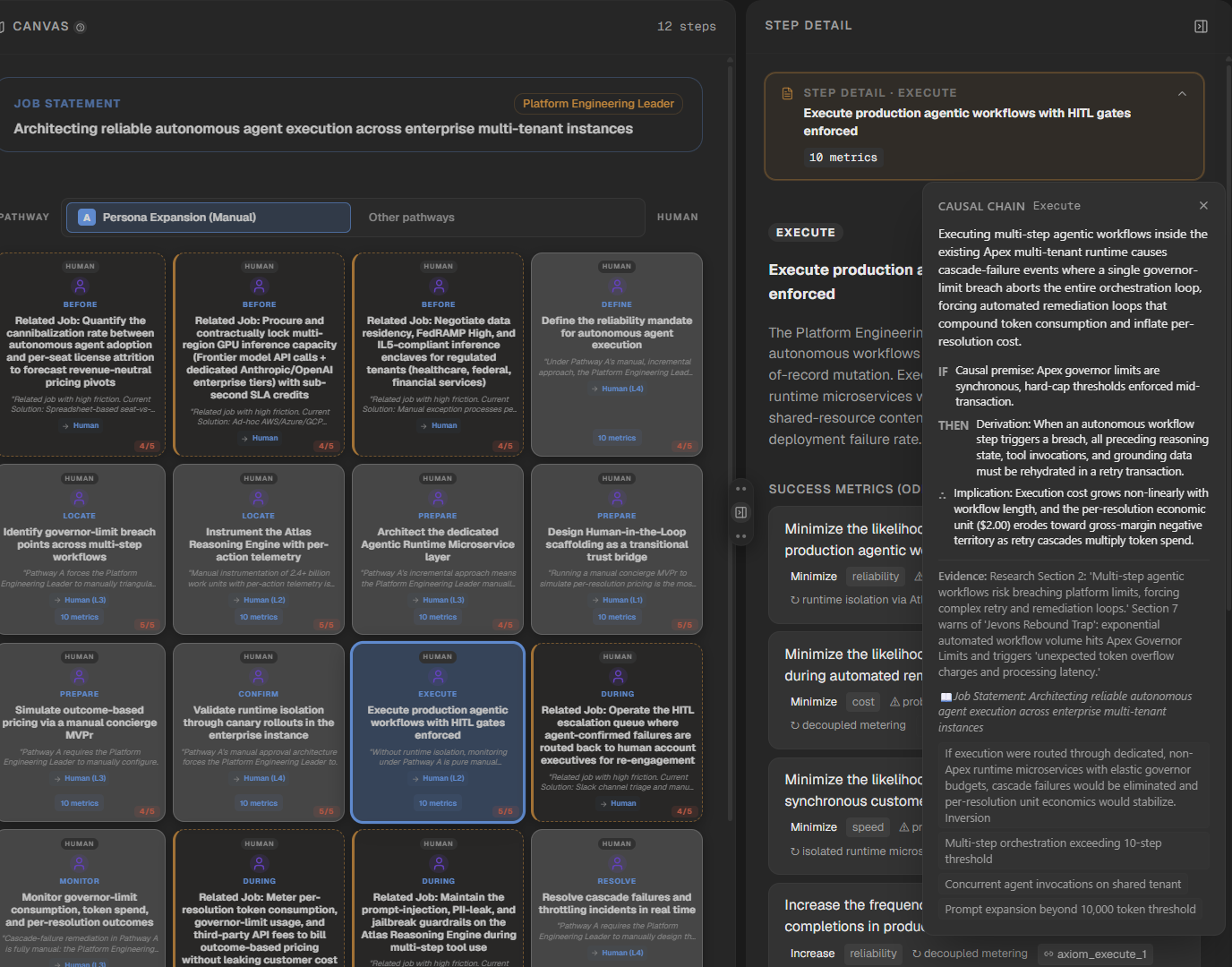
Job Maps, Metrics, and the Axioms they are derived from (i.e., not from consultants)
Who this Alpha is for
Leadership teams Mike Boysen advises. It's not a public signup. You get access by invite, through a call.
Leadership team
Decide if a growth plan will work before the company pays to build it.
The plan sounds good in a deck. The weak spots show up after the spend.
A checked plan, with the weak spots named, before you commit.
Operator who owns the plan
Show the rest of the leadership team why the plan should go ahead or stop.
The debate stays a matter of opinion.
The same steps, run the same way, so the team can check the work.
Team already working with Mike
Use the Alpha on a live strategy, with Mike Boysen in the loop.
A public signup doesn't fit a private advisory.
You book a call. If it's a fit, you get an invite.
Questions
Plain answers about the Alpha and the words on this page.